


Documents and records are a part of any business. From financial statements and employee files to articles of incorporation, every company has a number of important documents to maintain. As the organization grows, more documents accumulate. Keeping track of them is crucial to both operating efficiently and maintaining regulatory compliance.
All businesses are required to keep documents and records for a certain amount of time, but the specific requirements vary by company and industry. Read on or watch the video at the end of this post to learn about records retention management and how to best track retention for your organization.
What Is Records Retention?
A records retention program includes the systematic storage, tracking, and destruction of business documents and records. Through this program, organizations can more easily identify the documents that need to be kept, and the amount of time they must be kept. Guidelines differ for almost every type of document — this includes how long they should be kept, what ways they should be stored, and the method of destruction used once the retention period is up.
Why Is Records Retention Important?
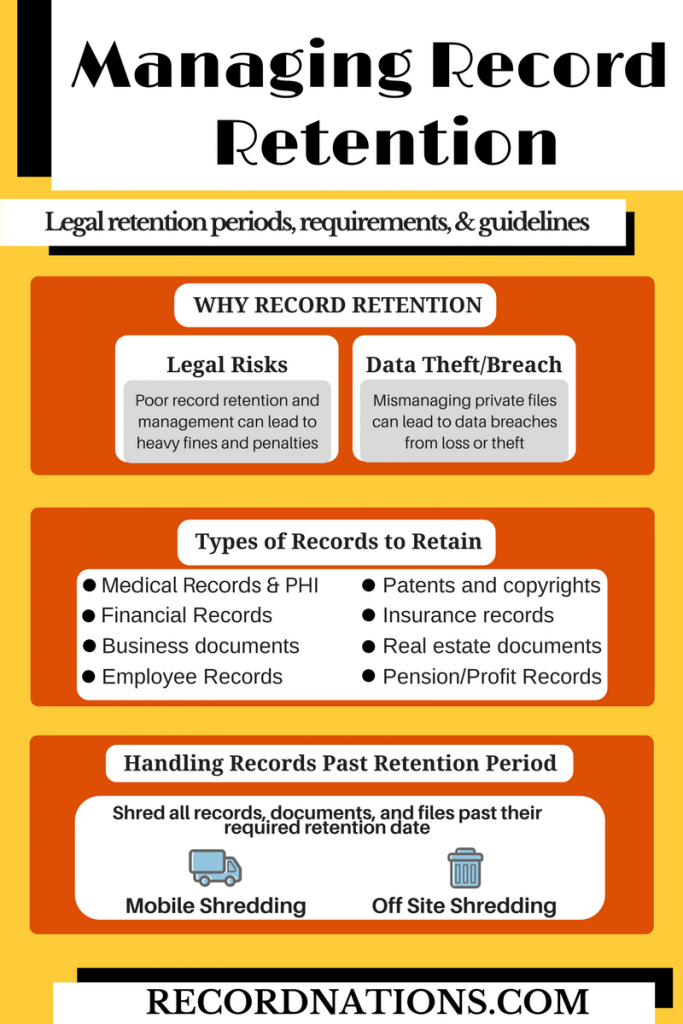
Record retention is important for a number of reasons. Arguably the most critical reason, retention programs protect you in litigation and help ensure compliance with federal and state retention laws. If you fail to comply with retention requirements, the consequences can be heavy.
For example, banking giant Morgan Stanley was fined $13 million in 2017 for poor record retention and management (among other things). Aside from improperly storing client information, they also destroyed records before their required retention periods. This resulted in swift legal punishment for disposing of records too early. Evidence of a consistently enforced retention program proves to the court that the destruction of business records meets all rules and regulations and can help you sidestep serious fines.
Retention programs are also helpful in keeping your records lean. While retention of records is crucial, it’s just as necessary to dispose of certain records in a timely manner. For the most part, every document will eventually pass its retention period, which is when it becomes important to dispose of them.
If records pass their retention periods and start to accumulate, the danger is the increased chances for information to be stolen or lost. Think of it like holes in the wall surrounding your business—the more records you have, the more potential holes you can have. The more sensitive records you have stored, the more sensitive information there is to lose.
Which Records Require Retention?
When it comes to record retention, the type of record matters. While it’s safe to assume that most record types should be retained, here are some key documents that should always be retained.
- Medical records & protected health information (PHI)
- Financial documents
- Business records
- Employee & personnel files
- Patents, copyrights, and trademarks
- Insurance records
- Real estate documents
- Pension and profit sharing records
How Long Should Records Be Retained?
Knowing that different types of records have different requirements, it’s important to understand just how long certain documents should be kept. While the below isn’t a comprehensive list, it’ll give you an idea of general retention periods by type of business document.
Business Records
When it comes to business documents, many of them should be kept permanently. This includes articles of incorporation, bylaws, capital stock and bond records, contracts and agreements, legal correspondence, and meeting minutes.
Financial Records
While a few financial documents should be kept indefinitely (auditor’s reports, annual financial statements, general ledgers), many have specific retention periods. Bank debt deductions have a seven-year retention requirement, whereas documents like payroll journals, inventory lists, invoices, and time cards should only be kept for four years.
Medical Records and PHI
Retention of medical records and files containing PHI are handled slightly differently. These types of records are subject to the Health Insurance Portability and Accountability Act (HIPAA) requirements, which outline retention periods. Documents containing PHI are generally required to be kept for six years. However, some medical records have unique retention and disposal requirements, so it’s important to research what’s required for your records.

State-Specific Record Retention Periods
While a number of federal laws like HIPAA or Sarbanes-Oxley Act (SOX) govern retention (see the table below), there are also state-level retention requirements to comply with. State-level regulations vary across the country, so it’s important to do your due diligence to learn which are applicable to you.
| Law / Regulation | What It Covers | Who It Applies To | Key Requirement |
| HIPAA & HITECH | Protected health information (PHI) — storage, transmission, disposal | Healthcare providers, health plans, and their business associates | BAA required; breach notification; secure EHR systems |
| Gramm-Leach-Bliley Act (GLBA) | Non-public personal financial information | Banks, insurers, wealth managers, and financial service firms | Written security plan; vendor due diligence; safeguards rule |
| FACTA Disposal Rule | Consumer credit reports, scores, and related financial records | Any business that uses consumer credit information | Secure destruction of consumer financial data before disposal |
| Sarbanes-Oxley Act (SOX) | Corporate financial records, audit trails, and disclosures | Publicly traded companies and their subsidiaries | 7-year retention of financial records; strict audit protocols |
| FERPA | Student education records | Educational institutions receiving federal funding | Restricted access; parental/student consent for disclosure |
How Are Retention Periods Tracked?
It’s one thing to know how long records should be kept. It’s another to effectively track retention periods for each document you have. Luckily, there are different approaches to record retention management that can make the process much easier.
Electronic Document Management Systems
Nearly every record you retain can be scanned and converted to a digital format. Digital files create quick access and instant backups for a business’s entire record archives.
An electronic document management system (DMS) provides version control, remote retrieval, indexing, and optical character recognition (OCR). This makes it easy for businesses to track record retention times and retrieve documents remotely.
Record Storage Facilities
Some records are required to be kept as hard copies. However, creating an in-house storage area wastes space and is cost prohibitive. This is where off-site records storage comes in.
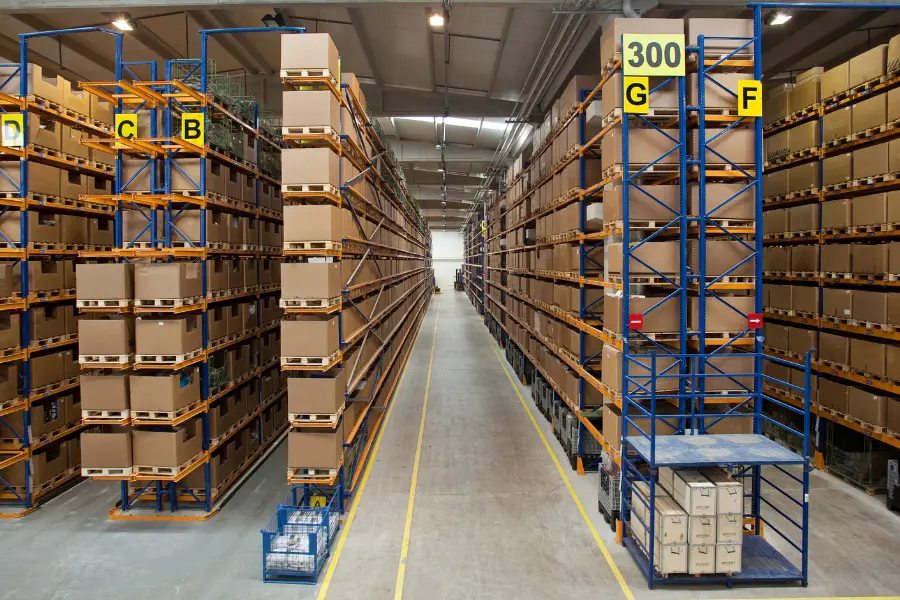
Off-site facilities store records in secure, climate-controlled areas with fire-suppression systems in place to ensure all threats are covered. Facilities typically index document inventories, keeping track of documents for easy retrieval once retention times are up.
What Happens When Retention Periods End?
Once records finally reach their retention requirements, they should be securely shredded and permanently destroyed according to relevant destruction requirements. While this part of the process can be done in-house, it’s much easier to work with professional document shredders to ensure compliance. Professional shredders can also provide a certificate of destruction as proof, which gives you the peace of mind that the information in your records can’t be recovered.
Some organizations or industries require the shredding of records to be witnessed. If you want to witness the shredding of your documents firsthand, mobile shredding is a great option.
Manage Retention With Record Nations
Managing retention periods isn’t the easiest task. It can, however, be easier with the right partner. Record Nations has more than 20 years of experience connecting businesses with document management professionals who offer simple solutions for records retention. From records scanning for easier document access, to off-site and cloud storage for streamlined retention, we can help.
Simply give us a call at (866) 385-3706 or fill out our form to get started. Whether you’re in Los Angeles or New York City, we’ll connect you with one or more of our nationwide providers for free, no-obligation quotes. Simplify your retention management with just one call!