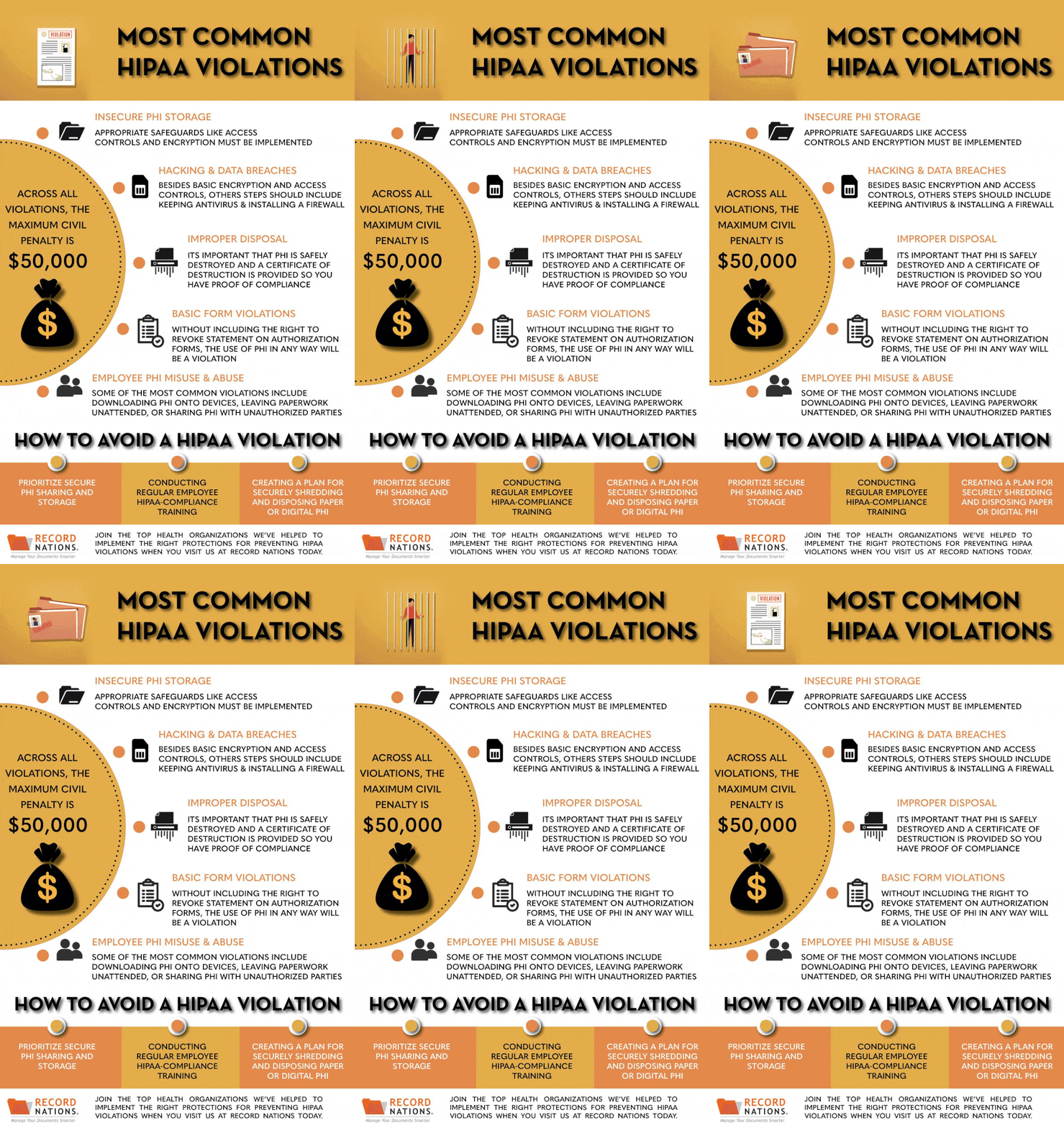
Learn more about HIPAA, the penalties for noncompliance, and the top 10 HIPAA violations by watching the video or reading the transcript below.
Penalties for HIPAA Noncompliance
Before diving into the different types of HIPAA violations themselves, it’s important you understand just how much you’re gambling with a potential HIPAA violation. While each violation type already has steep minimum financial penalties, they also have a maximum civil penalty. Across all violation types, the maximum civil penalty is $50,000, with an annual maximum of $1,500,000.
Violation Type
Minimum Civil Penalty
Unknowing Violation
$100 per violation–annual maximum of $25,000 for repeat violations
Violation from reasonable cause
$1,000 per violation–annual maximum of $100,000 for repeat violations
Violation due to willful neglect—corrected within required time period
$10,000 per violation–annual maximum of $250,000 for repeat violations
Violation due to willful neglect–uncorrected
$50,000 per violation–annual maximum of $1,000,000 for repeat violations
The Top 10 HIPAA Violations
#1: Insecure PHI Storage
PHI security is the primary focus of HIPAA. Moreover, there need to be appropriate safeguards like access controls and encryption implemented.
Additionally, they’re not just for your self-assurance—financial penalties for not implementing proper securities have gone as high as:
$16,000,000 for Anthem Inc. in 2018
$5,500,000 for Memorial Healthcare System in 2017
$3,200,000 for Children’s Medical Center of Dallas in 2017
$1,600,000 for the Texas Department of Aging and Disability Services in 2019
#2: Hacking & Data Breaches
Additionally, it’s important to protect PHI from being hacked and stolen by external bad actors. Besides implementing basic encryption and access controls, other steps to take to limit the risk of data breaches include:
It’s critical for employees to safely handle PHI. Additionally, this tends to be one of the most common sources of HIPAA violations.
In addition, there are a range of violations committed by employees that in turn need to be covered in HIPAA training programs, including:
Removing PHI from the facility
Downloading PHI onto unauthorized devices
Emailing/sending PHI to personal accounts
Accessing PHI from an unsecured device or location
Losing devices with PHI either by accident or theft
Leaving electronics and paperwork unattended
Speaking about and sharing PHI with unauthorized parties or family members
#4: Improper PHI Disclosure
If you have access to PHI, it would be a direct violation of HIPAA if you discuss it with an unauthorized person. Moreover, it’s critical to peptic this information, and disclosing information will lead to a direct violation.
Additionally, it may not be the first violation to come to mind when it comes to HIPAA compliance. However, it’s important to ensure PHI is only discussed with people who are directly involved, including:
Patients
Doctors and medical staff
Individuals billing the procedure
Pharmacists & other medication providers
Other general medical service providers
#5: Unsecure Technology to Share & Access PHI
Similar to the violation risk of removing PHI from a facility, accessing PHI from non-secure places can cause major violations. Additionally, this includes accessing from a home computer or sharing PHI over text. These are both common sources of violations because there’s a potential chance of exposure.
In addition, it’s recommended to implement a central electronic health records (EHR) system for storing information with tools. Also, these tools can include authentication, access controls, and encryption to protect PHI and ensure HIPAA compliance.
#6: Improper PHI Disposal
It’s important to properly dip PHI when it’s time. Additionally, this means ensuring proper and complete destruction. Although HIPAA doesn’t specify a method for destroying PHI, shredding services are frequently used because of their cost efficiency. Moreover, it’s because they provide certificates of destruction.
A certificate of destruction is a key tool that can be used to provide proof of HIPAA compliance in case of any legal disputes. Also, this includes information like where and when the shredding was done, who did it, and witness signatures.
#7: Not Performing an Organization-Wide Risk Analysis
It’s important to regularly conduct a risk assessment. Additionally, this helps organizations determine whether any vulnerability to the confidentiality, integrity, and availability of their PHI exists. Also, it’s beneficial for organizations to ensure their security, and it’s a requirement of HIPAA.
Recent HIPAA settlements for not conducting a risk analysis include:
$2,700,000 for Oregon Health & Science University
$2,500,000 for Cardionet
$850,000 for Lahey Hospital & Medical Center
$750,000 for Cancer Care Group
#8: Failing to Implement a Risk Management Process
It’s critical to conduct an organization risk assessment. However, the process doesn’t end there. Although performing a risk analysis will keep you HIPAA compliant, it’s necessary to follow it up by implementing a risk management process to address the identified risks.
Recent organizations who conducted a risk assessment but failed to act on them include:
$1,700,000 for the Alaska Department of Health and Social Services
$650,000 for the University of Massachusetts Amherst (UMass)
$400,000 for the Metro Community Provider Network
$150,000 for the Anchorage Community Mental Health Services
#9: Releasing PHI to an Unauthorized Party
The listed recipients are the only way to release a patient’s PHI. Additionally, disclosing the information to unauthorized parties is a direct violation of HIPAA.
This common violation is typically the result of one of the following errors:
PHI to unauthorized family members
The wrong patient’s PHI
PHI to 3rd parties that aren’t medically involved
#10: Basic Form Violations
The HIPAA Privacy Rule contains the right to revoke clause. Also, this is a statement on authorization forms to tell patients they can legally void their approval for entities to use and disclose their PHI.
Additionally, the use of PHI without the right to revoke statements on authorization forms will result in a HIPAA violation.
Tips for Avoiding These Top 10 HIPAA Violations
There is a steep financial penalty for HIPAA violations. Additionally, you must be taking steps to secure your PHI and keep employees up to date on the best practices for HIPAA compliance.
Moreover, things to keep in mind include:
Prioritizing secure PHI sharing & access as well as implementing encryption & access controls in EHRs.
Conduct regular employee HIPAA-compliance training & organization risk analyses.
Creating a plan for securely shredding and disposing of paper or digital PHI.
Avoid These Top 10 HIPAA Violations with Record Nations Today
At Record Nations, we partner with secure medical records storage and destruction services throughout the United States. In addition, Record Nations can help you find the provider that best fits your needs.
Start the process by filling out the form, give us a call at (866) 385-3706, or contact us directly through our live chat. Afterward, you’ll receive a free, no-obligation quote from services near you.
This website utilizes technologies such as cookies to enable essential site functionality, as well as for site improvement analytics and personalized services. We also share user traffic data with our analytics and search engine paid advertising platforms for improving performance of these campaigns. Personal information such as name, phone, email address and zip code is used by us and our servicing partners to contact you and service your request. By continuing to use this website, clicking OK, or by closing this notice using the 'X', you consent to the use of cookies. Not consenting or withdrawing consent, may adversely affect certain features and functions. To manage your preferences, please click on the Opt-Out Personal Information and Cookie Preferences link. You may also exercise your Do Not Sell My Personal Information option by clicking on the Opt-Out Personal Information and Cookie Preferences link.
Functional
Always active
The technical storage or access is strictly necessary for the legitimate purpose of enabling the use of a specific service explicitly requested by the subscriber or user, or for the sole purpose of carrying out the transmission of a communication over an electronic communications network.
Preferences
The technical storage or access is necessary for the legitimate purpose of storing preferences that are not requested by the subscriber or user.
Statistics
The technical storage or access that is used exclusively for statistical purposes.The technical storage or access that is used exclusively for anonymous statistical purposes. Without a subpoena, voluntary compliance on the part of your Internet Service Provider, or additional records from a third party, information stored or retrieved for this purpose alone cannot usually be used to identify you.
Marketing
The technical storage or access is required to create user profiles to send advertising, or to track the user on a website or across several websites for similar marketing purposes.
To provide the best experiences, we use technologies like cookies to store and/or access device information. Consenting to these technologies will allow us to process data such as browsing behavior or unique IDs on this site. Not consenting or withdrawing consent, may adversely affect certain features and functions.
Functional
Always active
The technical storage or access is strictly necessary for the legitimate purpose of enabling the use of a specific service explicitly requested by the subscriber or user, or for the sole purpose of carrying out the transmission of a communication over an electronic communications network.
Preferences
The technical storage or access is necessary for the legitimate purpose of storing preferences that are not requested by the subscriber or user.
Statistics
The technical storage or access that is used exclusively for statistical purposes.The technical storage or access that is used exclusively for anonymous statistical purposes. Without a subpoena, voluntary compliance on the part of your Internet Service Provider, or additional records from a third party, information stored or retrieved for this purpose alone cannot usually be used to identify you.
Marketing
The technical storage or access is required to create user profiles to send advertising, or to track the user on a website or across several websites for similar marketing purposes.