Scanning medical records and taking up a paperless practice offers benefits ranging from saving time to saving money. However, there are plenty more advantages in between, like:
≈ $55–$75 per employee monthly $660–$900 per employee annually
Example: 10 employees @ $16.50 per hour; 2 minutes filing records per day = $5.50 wasted daily $121 monthly $1,452 annually
Example: Five standard filing cabinets = 16.5 square feet; Average $1.80 per square foot = $30 spent per month $360 spent per year
Saving Time While Boosting Productivity
Using digital medical records helps to save time and in turn, improves productivity in several ways:
Space previously used for storage can instead be used for things like extra patient rooms
Record retention tracking systems can be configured to save time and remove record management chores
The time needed to find and re-file records is reduced and process prompts can be used to speed up documentation work
Simplify Storing & Managing Records
Digital medical records take up a fraction of the space paper records do. In turn, this helps to minimize the space needed for storage and the time it takes to sift through, find, and replace records when they’re needed.
For example, here’s a comparison of the max capacities for different storage types:
In addition to the sheer space and quantity of paper, when it comes to things like medical record retention times for HIPAA an EHR system can also be configured to automate retention tracking and notify you when times are about to expire.
Easily Find, Share, & Distribute Digital Medical Records
Once of the greatest post-scanning advantages is how digital medical records are indexed in electronic storage systems as they’re implemented.
File indexing lets you search for and sort filed by name, date created, and other filters. In addition to improved usability, digital medical records can also be easily copied and shared when necessary.
In modern healthcare, this is extremely valuable, as many procedures like surgeries, for example, require records to be shared with multiple healthcare providers or practices.
Save Time Using Patient Portals
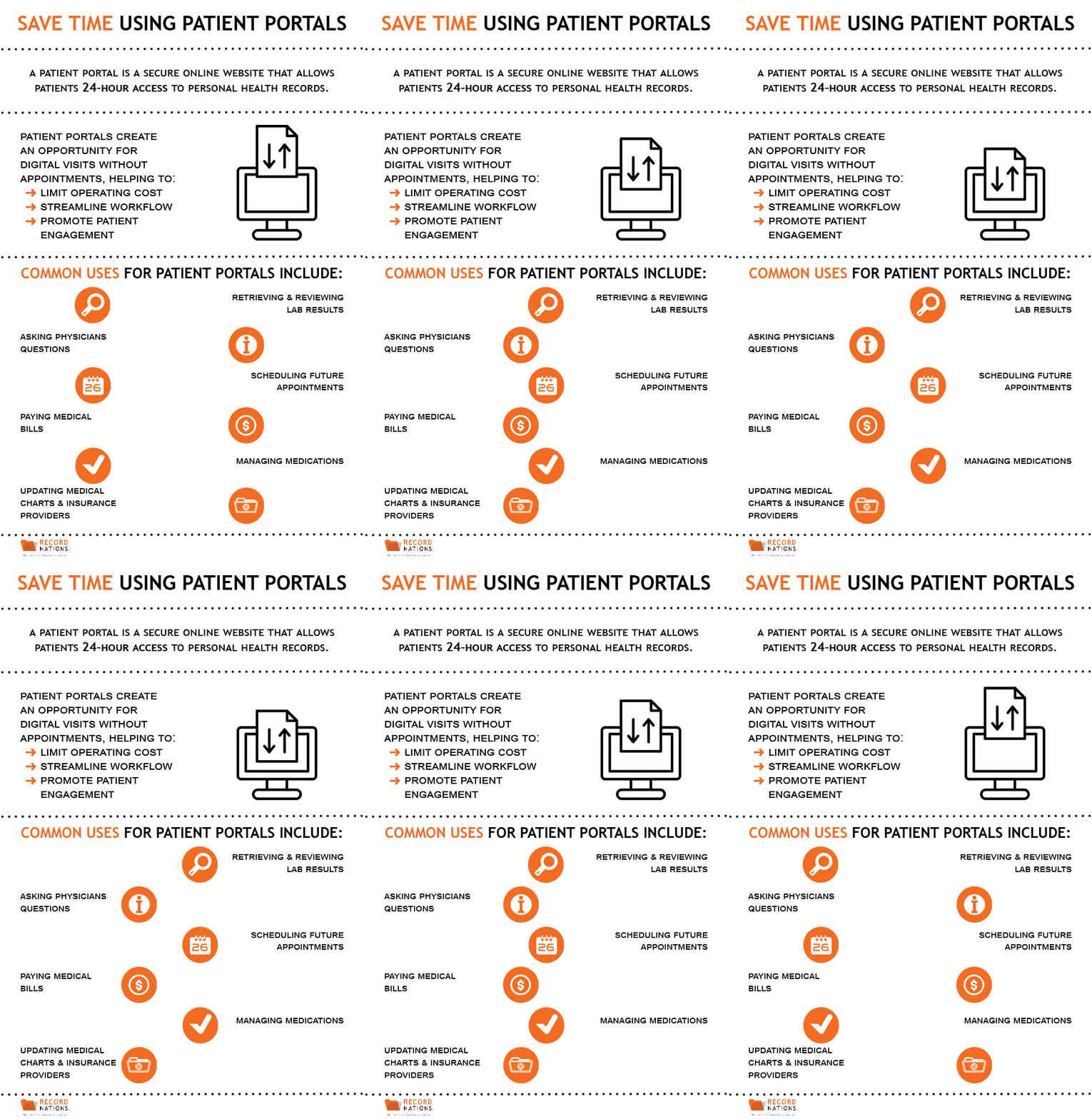
Using patient portals lets patients be digitally “seen” without needing to make an appointment or come in, in turn helping to limit operating costs while streamlining workflow. Common uses for patient portals include:
Encryption tools are used to protect files by encoding medical records so that even if there’s a breach, a decryption code is still required for access.
Tiered Access Controls
To build on basic encryption protections, tiered access controls can be used to require multiple decryption keys for sensitive information.
Ensuring HIPAA Compliance
There are multiple requirements for HIPAA compliance, namely medical record retention and the protection of the patient information itself.
A combination of medical record scanning’s other benefits ensures HIPAA is covered as well. With the ability to set up automated retention tracking, along with the protection of an EHR system’s securities, HIPAA compliance is built into the medical record scanning process.
Have Medical Records to Scan?
Record Nations can help you find the best scanning provider for your needs through our nationwide network of secure scanning service partners. To get started, fill out our form or give us a call at (866) 385-3706 for a free, no-obligation quote from providers in your area.
This website utilizes technologies such as cookies to enable essential site functionality, as well as for site improvement analytics and personalized services. We also share user traffic data with our analytics and search engine paid advertising platforms for improving performance of these campaigns. Personal information such as name, phone, email address and zip code is used by us and our servicing partners to contact you and service your request. By continuing to use this website, clicking OK, or by closing this notice using the 'X', you consent to the use of cookies. Not consenting or withdrawing consent, may adversely affect certain features and functions. To manage your preferences, please click on the Opt-Out Personal Information and Cookie Preferences link. You may also exercise your Do Not Sell My Personal Information option by clicking on the Opt-Out Personal Information and Cookie Preferences link.
Functional
Always active
The technical storage or access is strictly necessary for the legitimate purpose of enabling the use of a specific service explicitly requested by the subscriber or user, or for the sole purpose of carrying out the transmission of a communication over an electronic communications network.
Preferences
The technical storage or access is necessary for the legitimate purpose of storing preferences that are not requested by the subscriber or user.
Statistics
The technical storage or access that is used exclusively for statistical purposes.The technical storage or access that is used exclusively for anonymous statistical purposes. Without a subpoena, voluntary compliance on the part of your Internet Service Provider, or additional records from a third party, information stored or retrieved for this purpose alone cannot usually be used to identify you.
Marketing
The technical storage or access is required to create user profiles to send advertising, or to track the user on a website or across several websites for similar marketing purposes.
To provide the best experiences, we use technologies like cookies to store and/or access device information. Consenting to these technologies will allow us to process data such as browsing behavior or unique IDs on this site. Not consenting or withdrawing consent, may adversely affect certain features and functions.
Functional
Always active
The technical storage or access is strictly necessary for the legitimate purpose of enabling the use of a specific service explicitly requested by the subscriber or user, or for the sole purpose of carrying out the transmission of a communication over an electronic communications network.
Preferences
The technical storage or access is necessary for the legitimate purpose of storing preferences that are not requested by the subscriber or user.
Statistics
The technical storage or access that is used exclusively for statistical purposes.The technical storage or access that is used exclusively for anonymous statistical purposes. Without a subpoena, voluntary compliance on the part of your Internet Service Provider, or additional records from a third party, information stored or retrieved for this purpose alone cannot usually be used to identify you.
Marketing
The technical storage or access is required to create user profiles to send advertising, or to track the user on a website or across several websites for similar marketing purposes.